
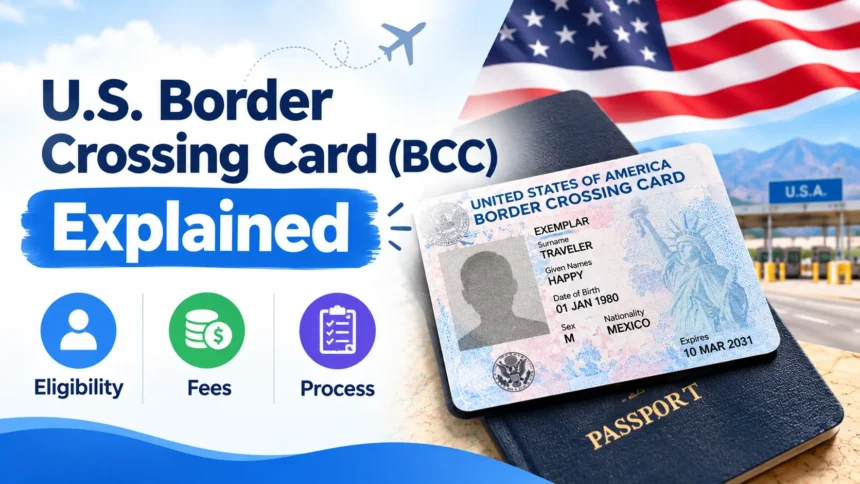
The U.S. Border Crossing Card (BCC) is a special travel document that allows eligible Mexican citizens to visit the United States for short trips, including tourism, shopping, family visits and certain business activities. It is particularly useful for people who regularly travel between Mexico and the United States.
In this guide, we’ll explain everything you need to know about the U.S. Border Crossing Card in 2026, including who can apply, the required documents needed, application fees, border travel limits, validity, renewal procedures, etc.
What Is a U.S. Border Crossing Card (BCC)?
A Border Crossing Card is a travel document issued by the U.S. Department of State to qualifying Mexican citizens who live in Mexico. The card combines two functions: it serves as a Border Crossing Card and as a B1/B2 nonimmigrant visitor visa.
The B1 category allows certain temporary business activities, such as attending meetings, conferences or negotiating contracts. The B2 category covers tourism, vacations, visiting relatives and certain medical visits.
The card includes security features and information that help U.S. border officials verify the traveler’s identity. Most Border Crossing Cards are valid for 10 years, although shorter validity periods apply to some cards issued to children. The BCC is intended for temporary visits. It does not grant permanent residence, U.S. citizenship or permission to take employment in the United States.
Who Is Eligible for a U.S. Border Crossing Card?
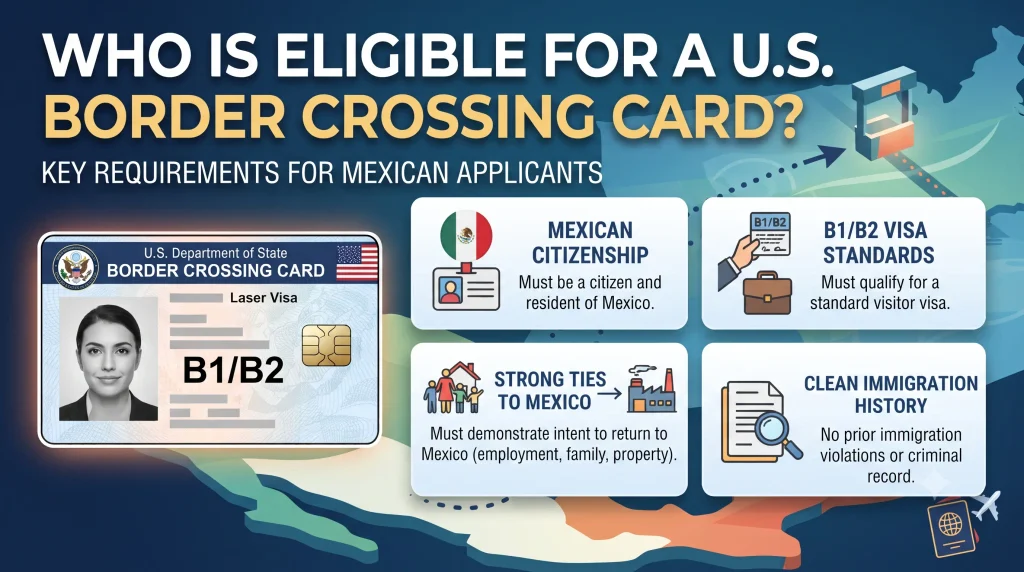
U.S. Border Crossing Card or BCC is specifically to Mexican citizens who meet its visitor visa requirements. To qualify, an applicant must meet below given conditions –
- Mexican citizenship: The applicant must be a citizen of Mexico.
- Residence in Mexico: The applicant must also reside in Mexico.
- Valid Mexican passport: A valid passport is required when applying.
- Temporary travel purpose: The visit must be for permitted business, tourism or other B1/B2 activities.
- Strong ties to Mexico: Applicants must demonstrate reasons to return to Mexico after their visit.
- Visitor visa eligibility: Applicants must satisfy the U.S. government’s general B1/B2 visa requirements.
For example, a Mexican citizen who works in Tijuana and frequently visits San Diego for shopping or family visits may be eligible for a Border Crossing Card, provided they meet the requirements. However, being a Mexican citizen does not automatically guarantee approval. Each application is reviewed individually by a U.S. consular officer.
What Can You Do With a Border Crossing Card?
A BCC allows its holder to request entry into the United States for the same general temporary purposes permitted under a B1/B2 visitor visa. These include:
- Tourism and vacations: Travelers can visit tourist attractions, explore cities, take short vacations and participate in recreational activities.
- Shopping: Mexican residents frequently use Border Crossing Cards for shopping trips to nearby U.S. cities, such as San Diego, El Paso and Laredo.
- Visiting family and friends: Cardholders may travel to see relatives or friends living in the United States.
- Business visits: BCC holders may attend meetings, trade events, conferences and certain other business activities that do not involve unauthorized employment.
- Medical treatment: Travelers may seek medical consultations or treatment in the United States, provided they meet the applicable visitor requirements.
A BCC does not authorize someone to work for a U.S. employer, enroll in a full academic degree program or move permanently to the United States. Travelers planning to work or study generally need an appropriate visa category.
How Far Can You Travel Into the United States With a BCC?
One of the most important things to understand about the Border Crossing Card is its geographic travel limits. Mexican citizens entering the United States by land with a valid BCC may qualify for short visits within designated border areas without obtaining Form I-94. The permitted distance varies by state.
| U.S. state | Distance allowed from the U.S.–Mexico border |
|---|---|
| California | 25 miles (40 km) |
| Arizona | 75 miles (121 km) |
| New Mexico | 55 miles (89 km) |
| Texas | 25 miles (40 km) |
For example, a Mexican resident visiting San Diego for shopping may be able to enter using only their valid BCC if they remain within the permitted border zone and meet the other requirements.
However, someone planning to travel farther into California, such as to Los Angeles, will generally need a valid passport and an I-94 admission record.
The same applies to travelers planning to visit cities such as Phoenix, Dallas, Las Vegas or New York. An I-94 allows a traveler to be admitted beyond the special border-zone limits, subject to the terms of admission set by U.S. Customs and Border Protection (CBP).
Read more – The Ultimate Guide to the U.S. Visa Waiver Program & ESTA
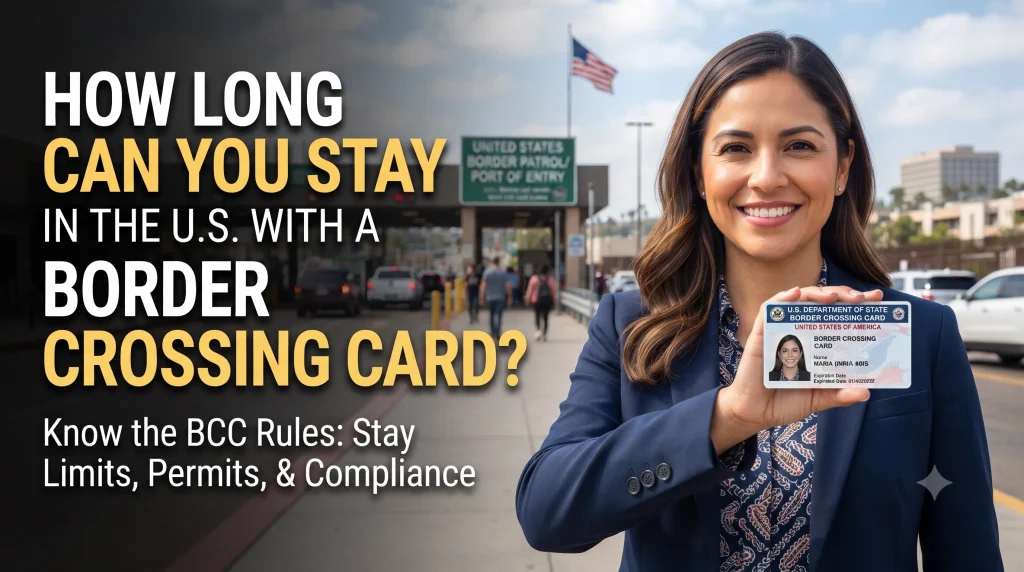
How Long Can You Stay in the U.S. With a Border Crossing Card?
The length of stay depends on the type of admission.
1. Travel within the border zone
Eligible Mexican citizens entering by land with a BCC can generally remain within the designated border zone for up to 30 days without an I-94. They must stay within the permitted geographic area and follow the conditions of their admission.
2. Travel beyond the border zone
For longer visits or travel beyond the designated border area, travelers generally need a passport and an I-94. As a B1/B2 visitor, a traveler may be admitted for up to six months, depending on the circumstances and the decision of the CBP officer.
Note – a BCC valid for 10 years does not allow someone to remain continuously in the United States for 10 years. Card validity and permitted length of stay are two different things.
Do You Need a Passport With a Border Crossing Card?
Whether you need to carry your Mexican passport depends on how you enter the United States.
For certain short visits directly from Mexico through a land border crossing, ferry or pleasure vessel, the BCC can be used as a standalone entry document. However, travelers arriving by commercial airplane or sea transportation must carry both their valid Mexican passport and BCC.
The BCC serves as the visa, while the passport provides the necessary travel identification.
| Type of travel | BCC alone accepted? |
|---|---|
| Direct land entry from Mexico for qualifying border-zone travel | Yes |
| Direct entry from Mexico by ferry or pleasure vessel under applicable rules | Yes |
| Travel beyond the border zone | Passport and I-94 generally required |
| Commercial flights to the United States | No, passport also required |
| Commercial sea travel | No, passport also required |
How to Apply for a U.S. Border Crossing Card
Applying for a Border Crossing Card is similar to applying for a U.S. B1/B2 visitor visa. Applications are handled through U.S. consular services in Mexico. You can follow the below given steps to apply for a BCC easily.
Complete Form DS-160
- Visit the official DS-160 application website.
- Enter your personal, passport, employment and travel details.
- Submit the form and save your confirmation page.
Pay the Application Fee
- Follow the official visa payment instructions for Mexico.
- Pay the applicable BCC application fee.
- Save the payment receipt for your records.
Schedule Your Appointments
- Visit the U.S. Embassy visa website.
- Book your biometrics appointment if required.
- Schedule a consular interview if required.
Attend the Biometrics Appointment
- Visit the designated application center.
- Provide fingerprints and a photograph if required.
- Bring the documents listed in your appointment instructions.
Attend the Visa Interview
- Visit the U.S. Embassy or Consulate if an interview is required.
- Explain your travel purpose and intended length of stay.
- Be prepared to discuss your employment, finances and ties to Mexico.
Receive Your Border Crossing Card
- Wait for the U.S. consulate’s application decision.
- Additional processing may be required in some cases.
- If approved, receive your BCC through the designated delivery service.
Documents Required for a Border Crossing Card
The exact documents requested may vary depending on the applicant’s circumstances. A valid Mexican passport is mandatory at the time of application. Other required documents are given below –
| Document | Purpose |
|---|---|
| Valid Mexican passport | Confirms identity and nationality |
| DS-160 confirmation page | Confirms submission of the online application |
| Appointment confirmation | Provides appointment details |
| Application fee receipt | Shows payment, when required |
| Previous U.S. visa or BCC | Provides earlier travel-document information |
| Employment or business records | May demonstrate employment and ties to Mexico |
| Financial records | May help demonstrate the ability to pay for the trip |
| Proof of residence | May help establish residence in Mexico |
| Travel itinerary | Explains the planned purpose and duration of travel |
Not every supporting document is mandatory for every applicant. The consulate may request additional evidence depending on the case.
U.S. Border Crossing Card Fees in 2026
The application fee depends on the applicant’s age and, for children, whether a parent or guardian meets the qualifying conditions.
Published U.S. Department of State BCC Application Fees
Standard Border Crossing Card application fee.
Reduced application fee for qualifying Mexican children.
Important: The reduced fee applies when at least one parent or guardian holds a valid BCC or is applying for one. Cards issued under this reduced-fee arrangement expire on the child’s 15th birthday. Paying the full fee allows a qualifying child to receive a card with the standard 10-year validity, subject to approval. Check the official U.S. visa fee schedule for current information.
Families may choose the applicable full-fee option for a child to receive a card with the standard 10-year validity, subject to approval.
Visa fees can change, and additional statutory charges may apply depending on the circumstances and implementation of current law. For more informations, you can visit the official U.S. visa fees page.
How Long Is a Border Crossing Card Valid?
Most Border Crossing Cards are valid for 10 years from the date of issuance. During its validity, the holder can generally use it for multiple visits to the United States, provided they continue to meet the entry requirements. However, children receiving a reduced-fee BCC may have a shorter validity period.
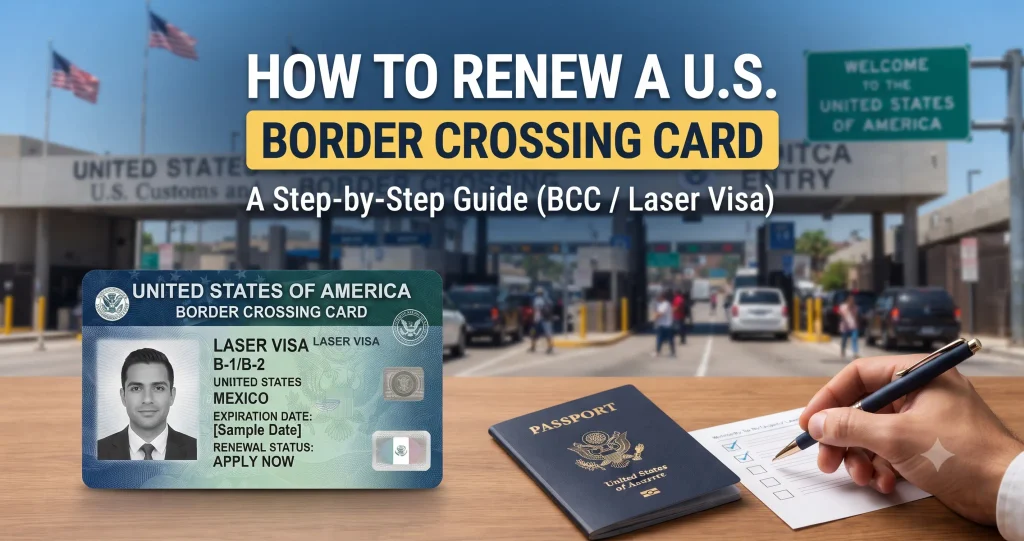
How to Renew a U.S. Border Crossing Card
A Border Crossing Card cannot be used after its expiration date. Travelers who want to continue visiting the United States must apply for a new card. The renewal process is generally similar to the initial application.
Applicants typically complete a new DS-160, pay the applicable fee and follow the appointment instructions provided by U.S. consular services in Mexico.
Can you renew a BCC without an interview?
Some applicants may qualify for an interview waiver.
Under the U.S. Department of State’s interview-waiver policy effective October 1, 2025, certain applicants renewing a full-validity Border Crossing Card within 12 months of its expiration may qualify, provided they were at least 18 years old when the previous card was issued.
Other conditions include applying in the country of nationality or usual residence, meeting visa eligibility requirements and having no disqualifying visa refusal or apparent ineligibility.
Even when an applicant qualifies for an interview waiver, a consular officer can still require an in-person interview. You should check the official instructions while filling the application.
What Is Form I-94, and When Do BCC Holders Need It?
Form I-94 is a U.S. arrival and departure record used to document a traveler’s admission and authorized period of stay. Not every BCC holder needs an I-94.
For example, a Mexican citizen entering by land for a shopping trip within the permitted border zone may qualify for the I-94 exemption. However, travelers planning to go beyond the permitted geographic area or remain longer than 30 days generally need an I-94.
How much does an I-94 cost?
As of October 2026, the published fee for an I-94 application at a land border is $30. The fee increased from $6 to $30 on September 30, 2025. You can find official informations about I-94 applications and admission records through the official CBP I-94 website.
Read more – K-1 Fiancé Visa Explained – Requirements, Fees, Steps
Border Crossing Card vs. B1/B2 Visa: What’s the Difference?
| Feature | Border Crossing Card (BCC) | Regular B1/B2 Visa |
|---|---|---|
| Eligibility | Mexican citizens residing in Mexico | Eligible applicants of various nationalities |
| Document format | Credit-card-sized document | Generally a visa placed in a passport |
| Main purpose | Tourism and temporary business | Tourism and temporary business |
| Validity | Generally 10 years | Depends on nationality and issuance |
| Multiple entries | Generally permitted | Depends on the visa |
| Passport-free border entry | Possible under specific rules | Generally not available |
| Employment permitted | No | No |
| Permanent residence granted | No | No |
Swipe left or right to view all columns on your mobile device.
The main advantage of the BCC is convenience for eligible Mexican residents who frequently make short trips across the U.S.–Mexico border.
Can You Enter the U.S. Multiple Times With a BCC?
Yes. A valid Border Crossing Card generally permits multiple entries during its validity period. Though Border officers may ask about the purpose of the visit, the intended destination and the expected duration of stay.
💡Advice – Frequent travel does not automatically violate the rules, but repeated lengthy visits or travel patterns suggesting that someone is living or working in the United States may raise questions.
Can You Work or Study in the United States With a BCC?
No, the BCC doesn’t permit Mexican persons to work or study in the United States. BCC holders may participate in permitted B1 business activities, such as meetings or conferences, but they cannot use the card to take ordinary employment in the United States.
If you want to study or work in U.S. as Mexican, you might need other appropriate visa needed for the purpose.
Read more – U.S. B1 & B2 Visa Guide: Eligibility, Fees & Interview Process
Can Children Apply for a Border Crossing Card?
Yes. Mexican children can apply for a Border Crossing Card. Children must meet the applicable nationality, residence and visa requirements. A valid Mexican passport is also required when applying.
Children do not automatically receive a BCC because their parents have one. Each child needs their own approved travel document.
Can a Border Crossing Card Application Be Denied?
Yes. The U.S. government can refuse a BCC application if the applicant does not satisfy the visa requirements. Possible reasons include insufficient evidence of temporary travel intentions, certain immigration violations, inaccurate information or other grounds of visa ineligibility.
For example, an applicant who cannot establish that they intend to return to Mexico after a temporary visit may be refused under the rules governing visitor visas.
What Happens if Your Border Crossing Card Is Lost or Stolen?
If your BCC is lost or stolen, report the incident to the appropriate authorities and contact the U.S. Embassy or Consulate for instructions. You should not attempt to travel using a lost, stolen, damaged or expired card. A replacement generally requires a new application and payment of the applicable fee.
If the card is lost while you are in the United States, seek guidance from the appropriate authorities about your travel documents before attempting to return.

Frequently Asked Questions
The below are the faqs asked mostly about U.S. Border Crossing Card.
Is a Border Crossing Card the same as a U.S. visa?
Yes, the modern DSP-150 Border Crossing Card also serves as a B1/B2 visitor visa. However, it has special rules for qualifying border-zone travel and particularly issued to Mexican citizens.
Can a Mexican citizen travel to New York with a BCC?
Yes. A BCC holder may travel to New York for a permitted temporary visit, provided they carry the required passport and obtain the appropriate admission documentation, including an I-94 when required.
Can a BCC holder fly within the United States?
Yes, provided the traveler has been lawfully admitted for travel beyond the border zone and meets the airline’s and TSA’s identification requirements, a BCC holder can fly within the United States. Though a BCC alone does not eliminate immigration restrictions.
Can a BCC holder fly from Mexico to the United States?
Yes, but they must carry a valid Mexican passport along with the BCC. The card alone is not sufficient for entry by commercial air travel.
Can permanent residents of Mexico who are not Mexican citizens apply for a BCC?
No. BCCs are issued only to people who are both citizens of Mexico and residents of Mexico. A foreign citizen living in Mexico generally needs another appropriate travel document to enter United States.
Can you use a BCC to live permanently in the United States?
No. The card is intended for temporary visits and does not grant permanent resident status.
How long does it take to get a Border Crossing Card?
Processing times vary depending on appointment availability, the consular office, application review and document delivery. Applicants should check current appointment information and apply well before their intended travel dates.
Can you renew a Border Crossing Card before it expires?
Yes. Eligible travelers can apply for a new card before their existing one expires. Some qualifying renewal applicants may be eligible for an interview waiver.