

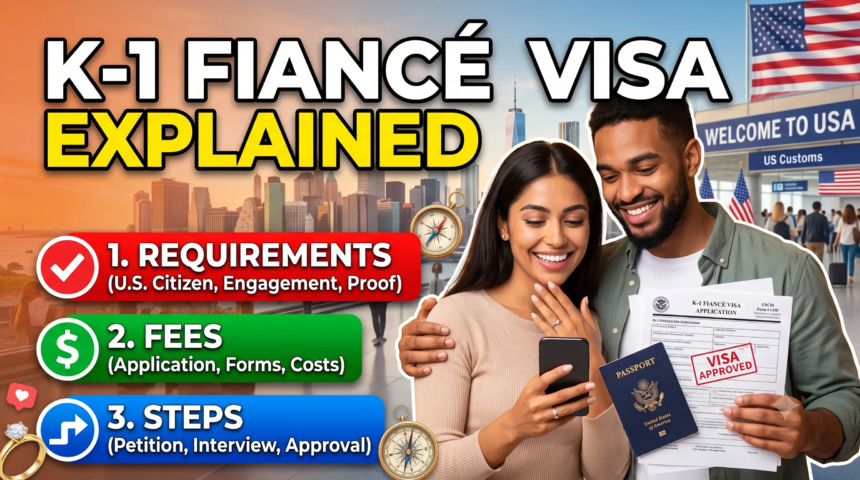
If either you or your partner isn’t a U.S. citizen and you both want to become residents of the United States and settle there, then K-1 Fiancé visa may be a great option for you. In this article, I explain the K-1 fiancé visa, requirements, fees, the application process, and everything you need to know about it.
What Is K-1 Visa?
The K-1 visa is a nonimmigrant visa designed specifically for the foreign fiancé(e) of a U.S. citizen. It acts as a temporary entry permit that allows your partner to come to the United States for up to 90 days. During those 90 days, you must legally get married. Once married, your spouse can apply to adjust their status to become a Permanent Resident (Green Card holder).
Key K1 Visa Benefits
- Fast Track to Togetherness: It brings your fiancé(e) to the U.S. so you can start living together while completing the permanent residence application.
- Work Authorization: Your partner can apply for a work permit (Form I-765) alongside their Green Card application after marriage.
- Travel Flexibility (Post-Filing): Once adjustment of status and travel permission (Advance Parole) are filed, your spouse can travel abroad and return safely.
- K-2 Visas for Children: Unmarried children under 21 of the foreign fiancé(e) can come along to the U.S. on dependent K-2 visas.
K1 Visa Requirements
Before starting your k1 visa application, both you and your partner must meet distinct legal criteria set by U.S. Citizenship and Immigration Services (USCIS):
- U.S. Citizenship: The petitioner (sponsor) must be a legal U.S. citizen by birth or naturalization. Permanent residents (Green Card holders) are not eligible to file a K-1 petition.
- Intent to Marry: You both must sign sworn declaration statements proving your intention to marry within 90 days of the foreign partner entering the United States.
- Legal Freedom to Marry: Both partners must be single and legally eligible to marry. Any prior marriages for either partner must be officially terminated via a final divorce decree, annulment, or death certificate before filing.
- In-Person Meeting: You must have met each other in person at least once within the 2-year window immediately preceding your petition submission. Exceptions are rare and granted only for extreme physical hardship or strict cultural customs.
Financial Eligibility: K1 Visa Income Requirements 2026
The U.S. sponsor must show they have the financial capability to support their partner so the immigrant will not rely on government assistance. Under the k1 visa income requirements 2026, the U.S. sponsor must earn at least 100% of the Federal Poverty Guidelines for their household size during the consular stage (using Form I-134). Once married, when filing for the Green Card (Form I-864), the requirement increases to 125%.
| Household Size | Consular Stage (100% Poverty Level) | Green Card Stage (125% Poverty Level) |
| 2 People (Sponsor + Fiancé) | ~$21,640 | ~$27,050 |
| 3 People (e.g., + 1 Child) | ~$27,320 | ~$34,150 |
| 4 People (e.g., + 2 Children) | ~$33,000 | ~$41,250 |
| Each Additional Person | + ~$5,680 | + ~$7,100 |
Note: Figures apply to the 48 contiguous states. Rates are higher in Alaska and Hawaii. If the sponsor does not meet the income threshold, the applicant may use high-value assets or a joint sponsor, depending on consulate rules.
The Step-by-Step K1 Visa Instructions
By following the below given detailed step by step process, you can apply for K-1 visa properly. Following clear k1 visa instructions prevents processing delays and expensive mistakes.
Step 1: Petition Submission (Form I-129F)
The U.S. citizen files Form I-129F (Petition for Alien Fiancé) with USCIS. This package must include primary proof of citizenship, passport photos, sworn statements of intent, and extensive documentation of your physical meetings (airline tickets, hotel bills, photos together).
Step 2: NVC Processing & Transfer
Once USCIS approves the I-129F petition, the file moves to the National Visa Center (NVC). The NVC processes the file, assigns a case number, and routes it directly to the U.S. Embassy or Consulate in the foreign partner’s home country.
Step 3: Online Visa Application (DS-160)
When notified by the embassy, the foreign fiancé(e) fills out the online DS-160 nonimmigrant visa application form, uploads a digital photo, pays the visa application fee, and prints the confirmation page.
Step 4: Medical Exam for K1 Visa
Before attending the interview, the foreign partner must complete a medical exam for k1 visa validation.
- Approved Doctors Only: The exam must be performed by an embassy-certified panel physician.
- Checkup Scope: It includes physical examinations, chest X-rays, blood sampling, and mandatory vaccination reviews.
- Results: The doctor submits the results directly to the embassy or gives the applicant a sealed envelope to bring to the interview.
Step 5: The K1 Visa Interview
The foreign partner attends the k1 visa interview at the local U.S. Embassy or Consulate. The consular officer asks questions about how you met, your plans, and your relationship history to verify that the commitment is genuine.
Step 6: Entry into the U.S. & Wedding
Once approved, the foreign partner receives the K-1 visa foil in their passport and enters the U.S. within 6 months. From the date of entry, you have exactly 90 calendar days to legally marry.
K1 Visa Processing Time 2026
The estimated overall k1 visa processing time in 2026 ranges from 10 to 16 months from initial filing to U.S. entry.
| Processing Stage | Responsible Agency | Estimated Duration |
| Form I-129F Approval | USCIS Service Center | 5 to 9 Months |
| NVC Transfer & Setup | National Visa Center | 1 to 2 Months |
| Consulate Medical & Interview | U.S. Embassy / Consulate | 2 to 5 Months |
| Total Estimated Time | — | 10 to 16 Months |
K1 Visa Processing Time by Country
The k1 visa processing time by country fluctuates depending on embassy workloads, local operational capacity, and regional demand:
- High-Volume Consulates (e.g., Manila, Philippines; Ciudad Juárez, Mexico; Lagos, Nigeria): Wait times for interview slots often take more 3 to 6 months to the standard baseline.
- Lower-Volume Consulates (e.g., London, UK; Sydney, Australia; Frankfurt, Germany): Interview appointments are typically scheduled within a few weeks of receiving NVC documents.

FAQs
The following are the frequently asked questions about the K-1 visa online.
Is the K-1 visa information available in other languages?
Yes. International couples frequently access k1 visa information explained in Spanish (el proceso de la visa K-1 de prometido explicado) directly on U.S. Embassy web portals across Latin America and Spain to assist foreign applicants during consular processing.
What happens if we do not marry within 90 days?
The foreign partner’s lawful K-1 status automatically expires. They must leave the U.S. immediately, as the 90-day time period cannot be extended under any circumstances.
Can a joint sponsor be used for financial eligibility?
Yes, if the U.S. citizen sponsor does not meet the income criteria, most U.S. consulates permit a joint sponsor to fill out Form I-134 and provide financial backing.
What happens if our K-1 visa petition receives a Request for Evidence (RFE)?
A Request for Evidence (RFE) means USCIS needs additional documentation before deciding on your Form I-129F. An RFE does not mean a denial, but failing to respond by the specified deadline (usually 30 to 87 days) will result in a rejection. Common triggers include missing proof of your in-person meeting, unclear divorce decrees, or thin proof of a genuine relationship. Submitting a complete response quickly keeps your file moving with minimal delay.
Can the foreign fiancé work immediately upon arriving in the United States?
No. While a K-1 visa holder is technically eligible for employment authorization upon entry, applying for a standalone work permit immediately on arrival requires a separate filing fee and often takes months to process—rendering it impractical during the 90-day window. Instead, most couples get married quickly and file Form I-765 (Application for Employment Authorization) concurrently with Form I-485 (Adjustment of Status/Green Card application) to secure long-term work rights.