
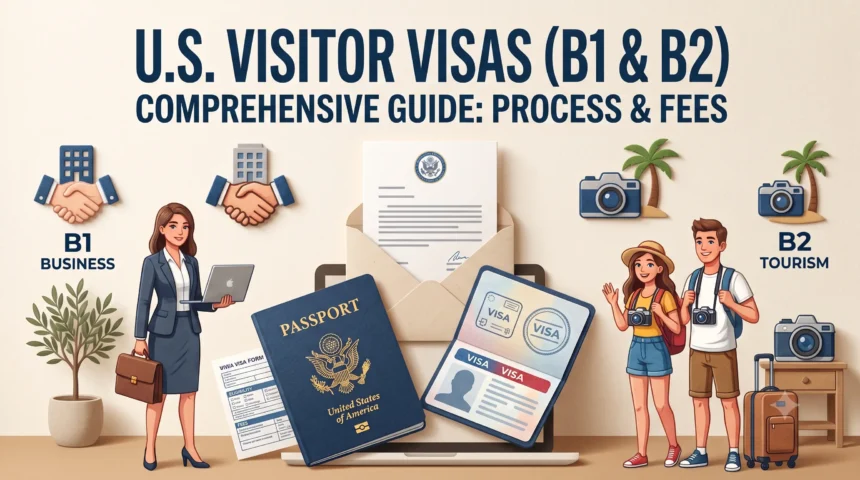
Planning a business trip, a family holiday, or travel for medical treatment in the United States requires the U.S. non-immigrant visa process if your passport does not qualify for the Visa Waiver Program (ESTA).
The B1 & B2 visitor visa is the primary entry route for non-immigrants visit to America temporarily. This guide details the entire lifecycle of the B1/B2 visa, including category rules, fees, DS-160 submission, whole application process and everything you need to know before applying for B1 or B2 visa.
What is the U.S. B1 & B2 Visa?
Under the U.S. Immigration and Nationality Act (INA), foreign citizens entering the U.S. temporarily for non-work purposes use either a B1 or B2 visa. These are the visas for travel, business visits or medical care.
- B-1 (Temporary Visitor for Business): It is given to foreign employer or commercial enterprise for non-employment activities that serve. Permitted tasks include attending scientific, educational, or business conferences; consulting with corporate partners or attorneys; negotiating contracts; and undertaking short-term non-credit company training.
- B-2 (Temporary Visitor for Pleasure or Medical Care): It is issued for purely personal visits. Permitted activities include tourism, visiting family and friends, receiving specialized medical treatment, and participating in uncompensated amateur social or athletic events.
| Visa Category | Primary Purpose | Examples of Permitted Activities |
|---|---|---|
| B1 Visa (Business) | Professional & Commercial | Attending conferences, meeting business partners, negotiating contracts, short training |
| B2 Visa (Tourism) | Leisure & Personal | Vacations, sightseeing, family visits, medical consultations, amateur social events |
| B1/B2 Combined | Dual-Purpose Entry | Allows you to attend a short seminar and spend the following week sightseeing |
Crucial Rule: Neither visa allows employment or working for a U.S. employer. Unauthorized employment violates your status and can lead to deportation or long-term travel bans.
Difference Between B1 & B2
The below are the key difference between U.S. B1 and B2 visa.
The B-1 Visitor for Business
The B-1 visa is strictly for activities that directly benefit a business located outside the United States. Permitted activities include:
- Consulting with business associates, legal counsel, or financial partners.
- Attending scientific, educational, professional, or business conventions and conferences.
- Negotiating and signing contracts, purchases, or supply orders.
- Participating in short-term internal training programs provided by an international parent company.
- Taking part in voluntary, uncompensated arbitration or settlement hearings.
The B-2 Visitor for Pleasure or Medical Treatment
The B-2 classification is strictly non-commercial and recreational. Permitted activities include:
- Leisure travel, vacations, sightseeing, and cross-country road trips.
- Visiting immediate family members, relatives, or friends residing in the U.S.
- Receiving medical consultations, surgeries, therapy, or experimental treatment.
- Participating in amateur musical, sports, or cultural contests (strictly unpaid, with no prize money beyond basic incidental reimbursement).
- Attending short, recreational, non-credit courses (such as a two-day culinary workshop or a weekend photography class).
| U.S. VISITOR VISAS | |
|---|---|
| B-1 BUSINESS | B-2 TOURISM |
Contract Negotiations
Trade Expos & Summits
Client Consultations
Short Corporate Training |
Vacations & Roadtrips
Family / Friend Visits
Medical Treatments
Amateur Competitions |
What Is NOT Allowed on a B1/B2 Visa?
One of the most important parts of understanding the B1/B2 visa is knowing what it does not allow means what you can’t do if you are in U.S. on a B1 or B2 visa. A visitor visa (B1 & B2) generally cannot be used for:
- Ordinary employment in the United States
- Full-time study
- Permanent residence
- Professional performances for a paying audience
- Working as a member of a ship or aircraft crew
- Working as foreign press, journalist or media personnel
- Other activities that require a different visa category
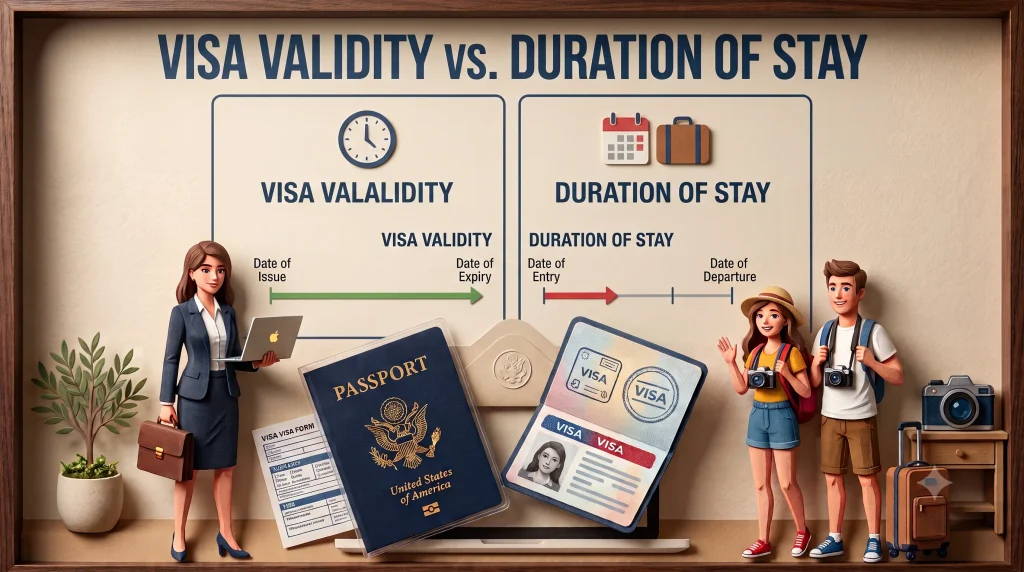
Visa Validity vs. Duration of Stay
The visa itself and the duration of your stay are two different things.
- Visa validity is how long you can use the visa to travel. It can be up to 10 years for many countries, but it is shorter for others. It depends on your nationality.
- Duration/Length of stay is how long you can stay each time you enter. A border officer decides this when you arrive, and it is usually up to 6 months. Your I-94 record shows the exact date you must leave.
A visa does not guarantee entry. The officer at the airport or border makes the final decision.
Eligibility Criteria
Under Section 214(b) of the U.S. Immigration and Nationality Act, consular officers are legally required to assume that every applicant intends to stay permanently. To qualify, you must actively overcome this presumption by demonstrating:
- A Clear, Temporary Purpose: Your itinerary, business agenda, or family gathering must be well-defined and time-bound.
- Strong Home Ties (Non-Immigrant Intent): Compelling proof that you will return home after your visit (e.g., permanent employment, property ownership, business investments, or immediate family).
- Financial Solvency: Sufficient funds in your accounts to cover flights, lodging, medical contingencies, and daily expenses without needing to work in the U.S.
- Valid Travel Documents: A passport valid for at least 6 months beyond your intended period of stay.
Also Read – K-1 Fiancé Visa Explained – Requirements, Fees, Steps
Application Fees and Expenses
Budgeting for your application involves a few key expenses:
- MRV Application Fee: The standard fee for a B1/B2 visa is $185 USD (payable in your local currency at official consular exchange rates). This fee is strictly non-refundable and non-transferable, even if an application is denied.
- Reciprocity Fees: Depending on your citizenship, an additional fee may be charged upon visa approval to match the fee your home country charges U.S. citizens.
- Other Costs: Professional 2×2 inch passport photos, document translations, courier fees, and travel to the embassy or consulate.
| Expense Item | Cost (USD) | Notes |
|---|---|---|
| MRV Application Fee | $185 | Standard, non-refundable fee covering DS-160 processing and interview scheduling. |
| Reciprocity / Issuance Fee | Varies | Country-dependent fee charged upon approval to match fees charged to U.S. citizens. |
| Ancillary Costs | $30 – $100 | Passport photos (2×2 inches), document translations, courier delivery, and travel to the embassy. |
Step-by-Step Application Process
1. Complete the Online Form DS-160
Visit the Consular Electronic Application Center (CEAC) website and submit Form DS-160. This detailed form records your travel history, personal background, employment, and planned address in the U.S. You can create your passport and visa photo online easily using Approva Visa.
- Save your Application ID immediately.
- Upload a digital photo meeting Department of State guidelines.
- Print the DS-160 Confirmation Page with the barcode upon submission.
2. Create an Account and Pay the Visa Fee
Register on your country’s designated U.S. visa scheduling portal (such as ustraveldocs or usvisascheduling). Generate the payment slip and complete the $185 payment via online banking, debit card, or designated bank branch.
3. Book Your Appointments
Most applicants require two separate appointments:
- Biometrics Appointment (VAC/OFC): To collect digital fingerprints and take your on-site photo.
- Consular Interview: An in-person interview at the U.S. Embassy or Consulate with a visa officer.
4. Assemble Your Supporting Documents
Bring these core items in an accessible folder:
- Valid passport and prior expired passports
- Printed DS-160 confirmation page
- Appointment confirmation letter
- Visa fee payment receipt
- Supporting evidence: Recent pay slips, employment letters, tax filings, bank statements (past 3 to 6 months), and property papers or business registration.
5. Attend the Interview
The consular interview usually takes only 2 to 5 minutes. Officers rarely review every document; instead, they assess your verbal answers for honesty, consistency, and clarity. State your plans simply, answer questions directly, and maintain eye contact.
Common Reasons for Visa Rejections
There are some reasons why people face rejection for U.S. B1 or B2 visa. By following the below steps, you can reduce your possibility of getting rejected heavily. Rest depends on you of course.
- Failure to Prove Strong Ties (Section 214b): Being young, unemployed, or having few assets in your home country can raise concerns about overstaying.
- Inconsistent Answers: Discrepancies between what you wrote on your DS-160 and what you state during your interview.
- Vague Travel Plans: Saying “I just want to visit” without knowing where you intend to go or whom you will stay with.
- Insufficient Financial Backing: Bank balances that do not support the high cost of traveling and lodging in the U.S.
Applying several months ahead of your expected departure date provides a comfortable buffer against seasonal interview appointment wait times.
FAQs
The following are the frequently asked questions about U.S. B1 and B2 visa on internet.
How long can I stay in the United States on a B1/B2 visa?
The visa validity printed on your passport foil (such as 5 or 10 years) allows you to travel to a U.S. port of entry, but it does not determine your duration of stay. Upon arrival, a U.S. Customs and Border Protection (CBP) officer inspects you and issues an electronic Form I-94, which grants an authorized stay—typically up to 6 months (180 days) per entry.
Can I work remotely for my home-country employer while in the U.S. on a B1/B2 visa?
No. The B1/B2 visa strictly prohibits entering the U.S. labor market. Performing full-time remote work—even for a foreign employer and paid into a foreign account—while residing in the United States is considered inconsistent with tourist status and can lead to questioning, entry denial, or visa revocation at the border.
What should I do if my B1/B2 visa is refused under Section 214(b)?
A Section 214(b) refusal means the consular officer determined you did not demonstrate sufficient economic, professional, or social ties to your home country. There is no appeal process. You should avoid reapplying immediately unless your circumstances have materially changed (e.g., higher stable income, longer employment tenure, or substantial asset accumulation).
Can I travel to the U.S. if my valid B1/B2 visa is in an expired passport?
Yes. As long as the visa foil itself is intact, undamaged, and has not been stamped “Cancelled,” it remains valid. When traveling, carry both your expired passport containing the valid visa and your new, valid passport. Both documents must show the same nationality and matching biographic details.
How much money must I show in my bank account for visa approval?
The U.S. Department of State does not mandate a fixed minimum bank balance. Instead, consular officers evaluate whether your available liquid funds, steady cash flow, and income realistically cover your estimated flights, accommodations, and daily expenses without needing to work in the U.S. Sudden, unexplained lump-sum deposits often raise suspicion.
Who is eligible for an interview waiver (Dropbox renewal)?
Applicants renewing an existing B1/B2 visa in the same category often qualify if their previous visa expired recently (typically within 12 to 48 months, depending on current consular post guidelines). In addition, children under age 14 and senior citizens over age 79 generally qualify for an interview waiver, provided they have no prior visa denials or arrests.
Can I apply to extend my stay or change my status while inside the U.S.?
Yes, by filing Form I-539 (Application to Extend/Change Nonimmigrant Status) with USCIS before the authorized stay date on your Form I-94 passes. However, applications submitted shortly after entering the country are scrutinized heavily under the “90-day rule,” as doing so may trigger an assumption of willful misrepresentation of your initial tourist intent.