
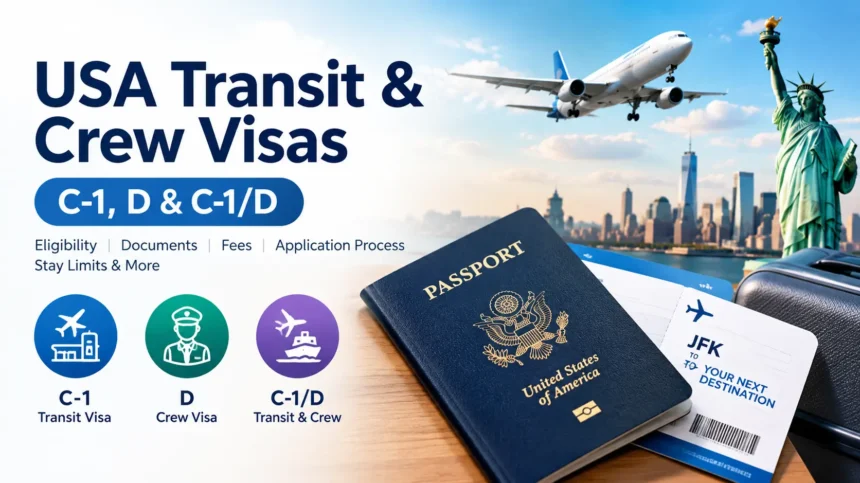
Are you traveling through the United States to another country or working aboard an international flight or ship? You may need a U.S. Transit Visa (C-1), Crewmember Visa (D), or combined C-1/D Visa. These visas are designed for international passengers and transportation workers who need to enter the United States temporarily.
What Are U.S. Transit and Crew Visas?
A U.S. Transit Visa allows eligible foreign nationals to pass through the United States while traveling to another country. Whereas a Crewmember Visa is issued for qualifying airline and ship employees performing their regular duties.
For example, an Indian passenger connecting through New York on the way to Mexico may need a transit visa. Meanwhile, a cruise ship employee flying to Miami to join a vessel may need a combined C-1/D Visa.
Types of U.S. Transit and Crew Visas
C-1 Visa
For transit passengers. Allows immediate and continuous transit through the United States to another country.
D Visa
For crew members. Intended for qualifying employees working aboard commercial aircraft or vessels.
C-1/D Visa
For transit and crew duties. Commonly used by crew members traveling to the United States to join their assigned ship or aircraft.
Other specialized classifications include the C-2 Visa for certain United Nations-related travel, the C-3 Visa for qualifying foreign government officials in transit, and the C-4/D-3 classifications for eligible maritime transfer crew members.
C-1 vs D vs C-1/D Visa: Key Differences
| Feature | C-1 | D | C-1/D |
|---|---|---|---|
| Purpose | Transit | Crew duties | Both |
| Who uses it? | Connecting passengers | Ship and airline crews | Crew members needing transit permission |
| Tourism allowed? | No | No | No |
| Ordinary maximum stay | 29 days | 29 days | 29 days |
| Standard application fee | $185 | $185 | $185 |
Who Needs a U.S. Transit or Crew Visa?
You may need one of these visas if you fall into the following categories:
- International passengers: Travelers connecting through a U.S. airport on their way to another country.
- Airline employees: Pilots, flight attendants and qualifying crew members working on international flights.
- Cruise ship workers: Employees performing qualifying duties aboard international cruise vessels.
- Maritime crew: Workers aboard cargo ships and other qualifying commercial vessels.
However, travelers who already hold a valid U.S. B-1/B-2 Visa may generally use it for transit. Read our detailed U.S. B1 & B2 Visa Guide to learn more about visitor visa eligibility, fees and the application process.
Eligible travelers from Visa Waiver Program countries may also transit using an approved ESTA instead of obtaining a separate transit visa. For more information, see our complete guide to the U.S. Visa Waiver Program and ESTA.
Eligibility Requirements
To qualify for a U.S. transit or crew visa, applicants generally need to demonstrate that their journey matches the requested visa category.
- A valid passport meeting applicable validity requirements.
- A genuine transit purpose or qualifying crew assignment.
- Evidence of onward travel or crew joining arrangements.
- Permission to enter the final destination, when required.
- Intention to depart the United States within the authorized period.
Crew visa applicants may also need to provide an employer’s letter explaining their position, assigned vessel or aircraft, and travel arrangements.
Documents Required
| Document | Why It Is Needed |
|---|---|
| Valid passport | Proof of identity and nationality |
| DS-160 confirmation | Confirms online visa application |
| Visa photo | Required when applicable under photo submission rules |
| Fee receipt | Proof of payment, if required |
| Travel itinerary | Supports the intended journey |
| Employer or joining letter | Supports qualifying crew duties |
How to Apply for a U.S. Transit or Crew Visa
- Choose the correct visa category. Determine whether you need C-1, D or C-1/D based on your travel purpose.
- Complete Form DS-160. Fill out the online application at the official DS-160 website and save your confirmation page.
- Pay the application fee. Follow the payment instructions provided by the U.S. Embassy or Consulate.
- Schedule your appointment. Book a visa interview through the applicable official appointment system.
- Attend the interview. Bring the required documents and explain your transit plans or crew duties.
- Receive the decision. If approved, follow the instructions for passport collection or delivery.
U.S. Transit and Crew Visa Fees and Stay Duration
The standard application processing fee for C-1, D and C-1/D visas is $185. Additional applicable government charges may depend on current rules and nationality.
These visas generally allow a maximum stay of 29 days under the ordinary transit and crew classifications. However, this is not a guaranteed stay period. Transit travelers must continue their journey without unnecessary delay, and crew members must comply with their admission conditions.
Can You Work or Visit Tourist Attractions?
A C-1/D Visa allows qualifying crew-related activities, not unrestricted employment in the United States. Crew members cannot use it to take unrelated jobs with American businesses.
Similarly, a C-1 Visa is intended for immediate transit rather than tourism. Travelers planning to visit attractions, take a holiday or spend time with relatives should consider an appropriate visitor visa instead. Go through our U.S. B1 and B2 Visa Guide if you want to travel to the United States.
Frequently Asked Questions
Do Indian citizens need a U.S. transit visa?
Generally, yes, unless they already hold an appropriate valid U.S. visa or qualify for another applicable exemption. A valid B-1/B-2 Visa can generally be used for transit.
Can I transit through the USA without a visa?
Some travelers qualify for visa-free transit, including eligible Visa Waiver Program nationals using ESTA and certain visa-exempt travelers. Requirements depend on nationality and travel circumstances. Read our Visa Waiver Program and ESTA guide for more details.
How much does a C-1/D Visa cost?
The standard application processing fee is $185. Other applicable charges may depend on current government rules and nationality.
Is a C-1/D Visa valid for five years?
It can be. For example, the standard reciprocity schedule for Indian nationals lists 60-month validity for C-1/D visas. Actual validity depends on nationality and the visa issued.
Can I leave the airport on a C-1 Visa?
A C-1 Visa is for immediate and continuous transit. Necessary movement during a genuine transit journey may be permitted, subject to admission rules, but it is not intended for sightseeing or an unrelated visit.
Can family members accompany a C-1/D Visa holder?
Family members do not automatically receive dependent status through a C-1/D Visa. They may need their own appropriate visa or travel authorization.
Can I extend my stay on a C-1/D Visa?
Ordinary transit and crew classifications are not designed for extended residence. Travelers should follow their authorized admission period and should not assume that an extension is available.
Conclusion
The U.S. C-1, D and C-1/D Visas serve different purposes. C-1 is primarily for international transit passengers, D is for qualifying crew members, and C-1/D for transit and crew-related permissions.
If you have any more questions about any U.S. Visa, ask us in the comment section below! 👇👇