
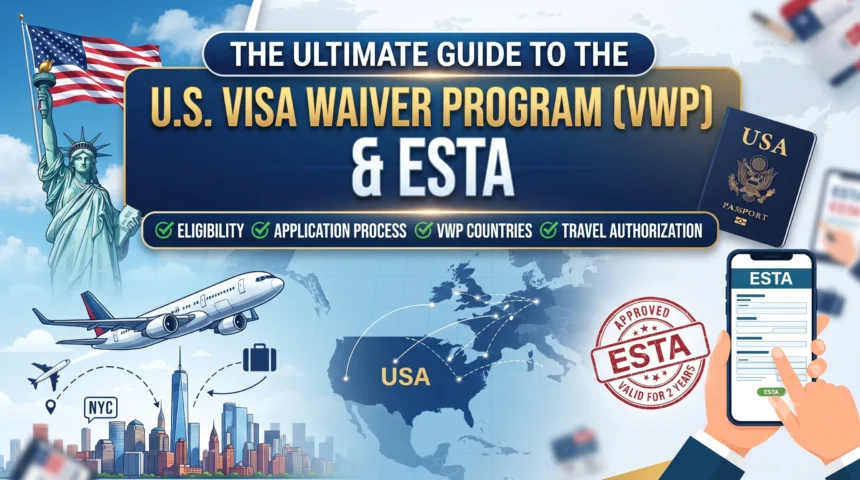
The U.S. Visa Waiver Program (VWP) allows citizens and nationals of certain countries to travel to the United States without obtaining a traditional U.S. visitor visa for short trips.
Under the program, eligible travelers can visit the United States for tourism, business, or transit for up to 90 days. However, visa-free travel does not mean that travelers can simply board a flight without completing any formalities. Most VWP travelers must obtain approval through the Electronic System for Travel Authorization (ESTA) before traveling.
What is the U.S. Visa Waiver Program?
The Visa Waiver Program (VWP) is a U.S. government program that allows eligible citizens or nationals of participating countries to travel to the United States without obtaining a traditional visa. Travel under the VWP is generally limited to 90 days or less and is permitted for qualifying tourism, business, or transit purposes.
Travelers must normally have an approved ESTA before boarding an eligible air or sea carrier to the United States. ESTA is an electronic travel authorization system operated by U.S. Customs and Border Protection (CBP).
According to The U.S. Department of State, Travelers can still apply for a visitor visa instead of using the VWP if they prefer to do so or if they do not qualify for the program.
Visa Waiver Program Countries
The following are the countries who are currently in U.S. visa waiver program. As of currently 42 countries are included in the program.
Who Can Use the Visa Waiver Program?
Eligibility depends on citizenship, passport technology, and personal travel history. To enter the U.S. under the VWP, you must meet four core criteria:
1. Citizenship of a Participating Country
You must be a full citizen or national of a participating country (such as the UK, France, Germany, Japan, South Korea, Australia, New Zealand, and Qatar). Permanent residents of these countries holding foreign passports from non-member nations do not qualify.
2. An E-Passport with Biometric Chip
Your passport must be an e-Passport featuring an integrated electronic chip that stores your biometric data and displays the international biometric symbol on the cover.
3. Purpose of Travel
Travel must align strictly with B-1/B-2 visitor activities:
- Allowed: Tourism, vacations, visiting family/friends, attending non-paid conferences, and business negotiations.
- Not Allowed: Paid employment by a U.S. entity, long-term university study for credit, live public performances for pay, or permanent relocation.
4. Approved Carrier & Return Ticket
You must arrive via an approved commercial air or sea carrier and possess a confirmed onward or return ticket departing North America within the 90-day window.
Disqualifications and Ineligibility Rules
Even if you hold a passport from a participating country, you cannot use the VWP if you meet any of the following statutory restrictions:
- Travel to High-Risk Nations: You have traveled to or been present in Iran, Iraq, Libya, Somalia, Sudan, Syria, or Yemen on or after March 1, 2011, or Cuba on or after January 12, 2021.
- Dual Citizenship: You hold dual citizenship with Cuba, Iran, Iraq, North Korea, Sudan, or Syria.
- Criminal History: You have been arrested or convicted of certain offenses, including crimes involving moral turpitude or controlled substances.
- Prior Immigration Violations: You previously overstayed an authorized stay or were denied entry to the United States.
If you fall into any of these categories, your ESTA will be rejected, and you must schedule an interview for a standard B-1/B-2 nonimmigrant visa at a U.S. Embassy or Consulate.
What Is ESTA?
ESTA stands for Electronic System for Travel Authorization. It is an electronic authorization system operated by U.S. Customs and Border Protection. A traveler normally needs ESTA approval before boarding a flight or ship to the United States under the Visa Waiver Program.
ESTA helps the U.S. government determine whether a traveler is eligible to travel under the VWP before the traveler begins the journey. Importantly, an approved ESTA does not guarantee admission to the United States. When a traveler arrives, CBP officers at the U.S. port of entry determine whether the traveler is admissible.
In other words: ESTA approval allows you to travel to a U.S. port of entry, but it does not guarantee that you will be admitted into the country.
Is the Visa Waiver Program the same as ESTA?
No. This is one of the most common points of confusion. Visa Waiver Program is the overall U.S. travel program that allows eligible nationals of participating countries to travel without a visa. ESTA is the electronic travel authorization that most VWP travelers need before boarding transportation to the United States.
A simple way to understand it is:
Visa Waiver Program = the travel program
ESTA = the travel authorization used for VWP travel
ESTA itself is not a visa. CBP describes ESTA as an automated system used to determine whether travelers are eligible to travel under the VWP and whether their travel presents certain law-enforcement or security concerns.
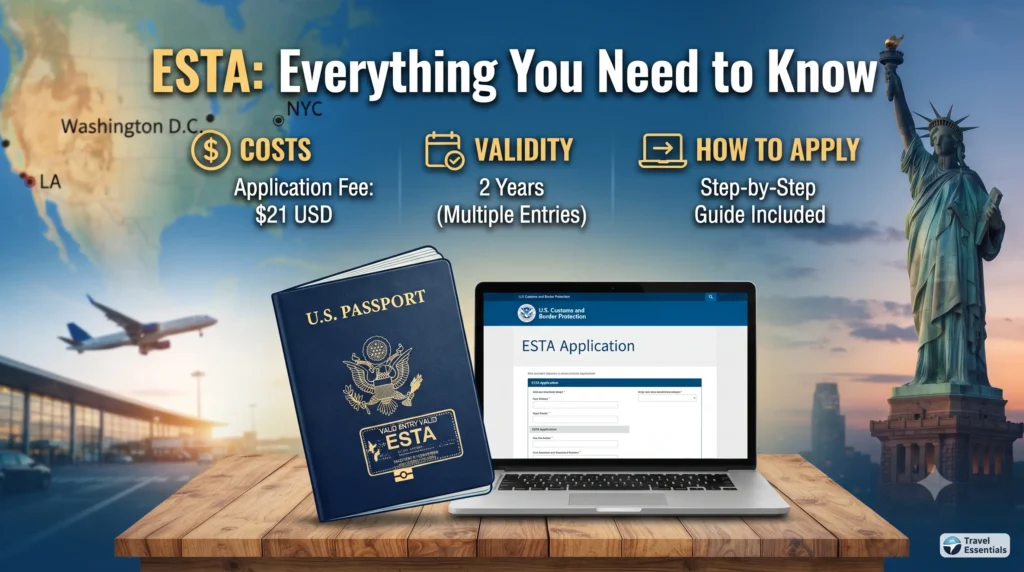
ESTA Costs, Validity, and How to Apply
An ESTA is not a visa; it is a digital pre-clearance authorization.
- Official Application: Always use the official government portal (
esta.cbp.dhs.gov) or the official CBP ESTA mobile app. Avoid third-party copycat websites that charge inflated processing fees. - Fee: $21 USD.
- Validity: Valid for 2 years or until your passport expires—whichever comes first. It allows multiple entries into the U.S. as long as no single visit exceeds 90 days.
- When to Apply: At least 72 hours before departure. While many applications receive automated approval in minutes, processing can take up to 3 days.
How Long Can You Stay in the U.S. Under the VWP?
The maximum permitted stay under the Visa Waiver Program is generally 90 days. The 90-day limit is important because VWP travelers generally cannot simply extend their stay if they want more time in the United States.
The State Department states that people admitted under the Visa Waiver Program, cannot extend their stay beyond the initial admission period. For this reason, travelers who know that they need to stay in the United States for longer than 90 days should look at the appropriate visa category instead of relying on the VWP.
What Travel is Allowed Under the Visa Waiver Program?
The VWP is primarily designed for short-term tourism, business and transit. The following travels are only allowed under the Visa Waiver Program or VWP.
Tourism
Travelers can generally use the VWP for activities such as:
- Vacation
- Sightseeing
- Visiting friends or relatives
- Tourism
- Certain medical treatment
- Participating in certain social events
- Participating in certain amateur sporting or cultural activities when the traveler is not being paid
The exact circumstances matter, so travelers should make sure their planned activity falls within the permitted visitor activities.
Business Travel Under the VWP
The VWP can also be used for certain short-term business activities.
Examples include:
- Meeting business associates
- Attending business meetings
- Attending professional or business conferences
- Negotiating contracts
- Attending certain short-term training programs
However, the VWP is not a work permit. Someone cannot use the VWP simply to take a job in the United States. The State Department specifically lists employment among activities that are not permitted under VWP travel.
Can You Study in the U.S. on the Visa Waiver Program?
Generally, no. The VWP does not allow someone to use a short visit as a substitute for an appropriate student visa. The State Department lists study for academic credit as an activity that is not permitted under the VWP.
A short recreational course that is not for academic credit may be allowed in certain circumstances, but formal study normally requires the appropriate visa category.
Can You Work in the U.S. With ESTA?
No. An ESTA is not a work authorization. VWP travelers cannot use the program to take ordinary employment in the United States. If someone wants to work in the United States, they generally need a different employment-based immigration or nonimmigrant visa category whichever applies to their situation.
3 Critical VWP Rules Every Traveler Must Know
1. The 90-Day Rule Is Absolute
Unlike a standard visa, you cannot request an extension of your 90-day stay under the VWP. Overstaying even by a single day revokes your ESTA immediately and permanently bars you from using the Visa Waiver Program in the future.
2. Side Trips Don’t Reset the Clock
Short excursions to Canada, Mexico, or adjacent Caribbean islands generally count toward your original 90-day allotment. You cannot reset your 90 days simply by crossing the Canadian or Mexican border for a weekend.
3. Entering with Dual Intent Can Be Deemed Fraud
Entering the U.S. under the VWP with the pre-planned intention of marrying a U.S. citizen and immediately filing for adjustment of status (Green Card) can trigger allegations of immigration fraud. Always consult an immigration attorney before traveling if your long-term goals involve adjusting status.
Is Canada Part of the Visa Waiver Program?
No. Canada is not a VWP country. However, Canadian citizens generally do not need a U.S. nonimmigrant visa for ordinary tourism and certain other visits because they benefit from separate U.S.-Canada entry rules.
Bermudian citizens also generally have separate visa exemptions for tourism and visits. Therefore, Canada should not be added to a list of VWP countries simply because many Canadian citizens can visit the United States without a visitor visa.
What About Romania and the Visa Waiver Program?
Currently Romania is not a part of Visa Waiver Program. In January 2025, the U.S. government announced Romania’s designation into the Visa Waiver Program. However, on May 2, 2025, the Department of Homeland Security announced that it had rescinded Romania’s VWP designation.
As a result, Romania does not appear on the current 42-country VWP list. This is an important reminder that VWP participation is not necessarily permanent. Countries must continue to meet applicable requirements, and the U.S. government can change a country’s designation.

FAQs
The following are the frequently asked questions about Visa Waiver Program on internet. Follow our website visaandpr.com for more such articles!
How long does it take for an ESTA application to be approved?
Most applications receive a response within minutes, but the official processing window can take up to 72 hours. Because approvals are not guaranteed to be instantaneous, it is strongly recommended that you submit your application at least 3 days before departure.
Can I extend my stay beyond 90 days while in the U.S.?
No. One of the strictest conditions of the Visa Waiver Program is that stays cannot be extended. Unlike standard B-1/B-2 visitor visas, you cannot file for an extension through USCIS. The only rare exception is an emergency preventing departure (such as hospitalization), which requires contacting U.S. Citizenship and Immigration Services (USCIS) for “Satisfactory Departure” authorization.
Do children need an ESTA?
Yes. Every traveler, regardless of age, must have their own valid e-Passport and an individual approved ESTA prior to boarding.
What should I do if my passport expires before my ESTA does?
Your ESTA is electronically linked to your specific passport. If your passport expires, your ESTA becomes invalid immediately—even if the original 2-year ESTA period has not ended. Once you receive your new passport, you must submit a fresh ESTA application and pay the application fee again.
Can I reset my 90-day limit by taking a quick trip to Canada, Mexico, or the Caribbean?
No. Under VWP regulations, short side trips to contiguous territory (Canada, Mexico) and adjacent islands are counted toward your original 90-day allotment. When you re-enter the U.S., you will generally only be admitted for the remaining balance of your initial 90 days, not given a fresh 90-day period.
What happens if my ESTA is denied?
An ESTA denial does not automatically mean you are barred from the U.S. It simply means you do not qualify for visa-free entry and must apply for a standard B-1/B-2 visitor visa via your nearest U.S. Embassy or Consulate.